HOW CYCLING REDUCES DEMENTIA RISK
What if one of the most powerful things you can do to prevent dementia isn’t a crossword, a Mediterranean diet or a nightly eight hours, but getting on your bike? The most recent research suggests it might be.
A major study of nearly 480,000 people, published in the revered medical journal JAMA, found that those who cycled regularly had a 22 per cent lower risk of Alzheimer’s. And for young-onset dementia, the kind that strikes before 65, cyclists’ risk was 40 per cent lower than that of non-cyclists.
Researchers believe cycling is uniquely protective because it combines cardiovascular exertion with balance and speed of processing – a key brain function that slows with age unless you train it – as you navigate hazards and the environment around you.
As a teenager, I’d cycle 30 miles four times a week on a racing bike through the rolling Worcestershire countryside. Then 14 miles every day to and from work when I moved to London. But eight years ago, I came off my bike with an overloaded pannier in the middle of a busy road and decided it was time to stop.
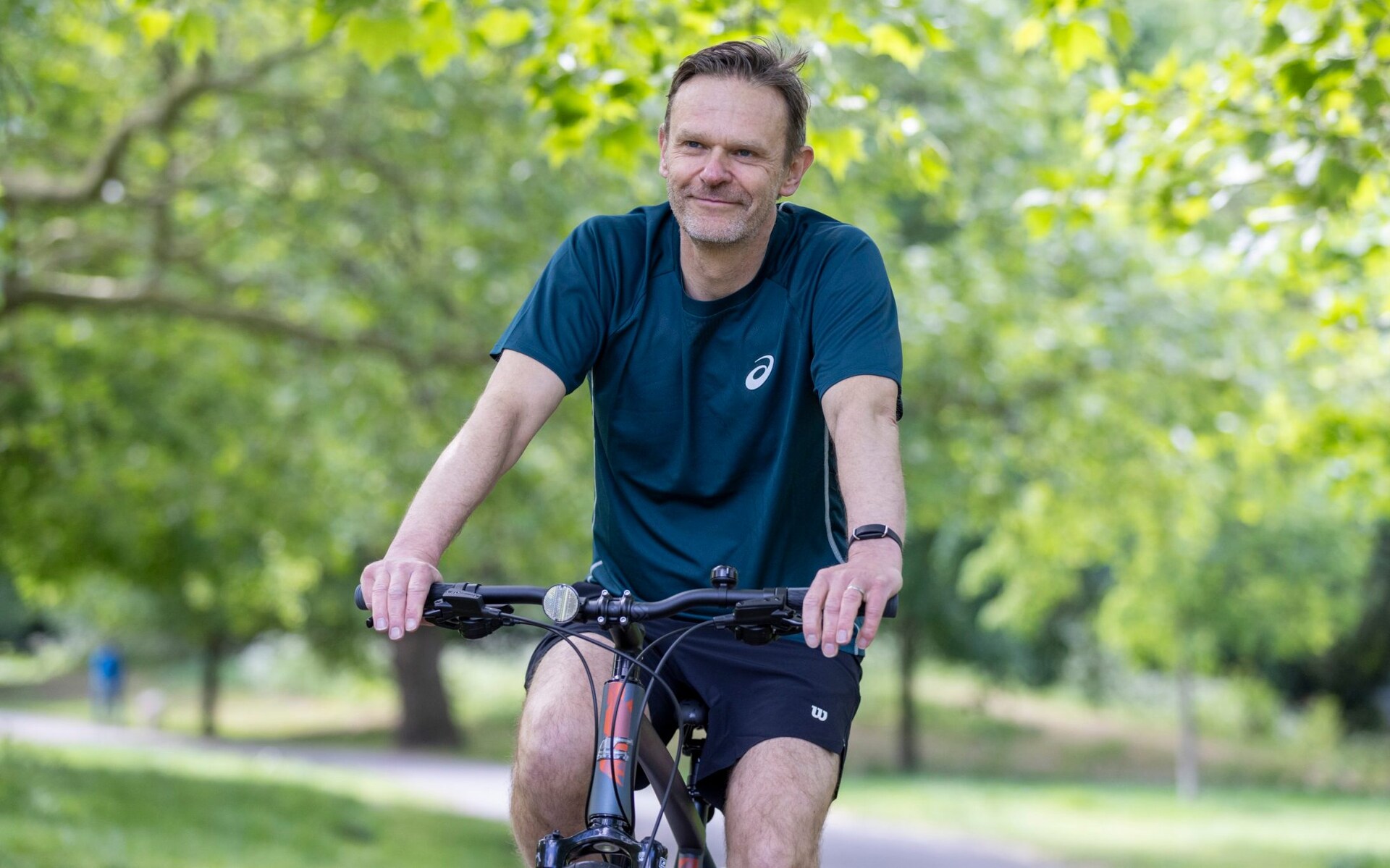
Seeing the latest evidence on its health benefits for the brain, I thought, at 53, it’s time for me to get back on two wheels again. I’m now easily doing 20 miles a week. Not only am I doing more cardiovascular exercise, but I can feel how it is keeping my brain more alert as I navigate bends, remember my route (you can’t passively follow a satnav when you’re cycling) and avoid hazards at speed.
Read on to see how cycling protects the brain. And why me and my two fellow cycling fans in their 70s (see below) have decided it’s worth taking up again.
Cycling works the brain in a way walking doesn’t
The reason cycling appears to outperform walking for brain health may come down to how much the brain has to do while you’re on a bike.
Professor Stuart Gray studies the effects of exercise on the body and brain at the University of Glasgow’s School of Cardiovascular and Metabolic Health. He says the cognitive demands of cycling on the road are not trivial. “From a cognition point of view, you are actively working the brain to keep alert about traffic,” he explains. “As someone who cycles to work and is constantly watching out for cars coming to hit me, that load can be large.”
Scientists call this “dual-tasking” – exercising the body and the brain at the same time – and it has emerged as one of the most promising areas in dementia prevention research, prompting a significant improvement in planning skills, decision-making and mental flexibility, all of which decline first in people with Alzheimer’s.
It could grow the memory centres of your brain
The most striking finding from the JAMA study was that cyclists’ brains looked physically different on a scan. They had larger hippocampus – the seahorse-shaped structures, deep in the brain, where short-term memory is converted into long-term memory, and where the damage of Alzheimer’s first becomes visible.
“In older adults, a larger hippocampal volume is linked to better episodic memory, verbal learning and executive function (such as planning, decision-making and mental flexibility),” says Professor Melody Ding, who led the JAMA study at the University of Sydney’s School of Public Health.
Crucially, she says, “slower hippocampal shrinkage is associated with slower cognitive decline, even in people who already have Alzheimer’s-related pathology” – meaning that, even after the disease has begun to take hold, exercise may delay its symptoms.
It boosts heart health
Exercise protects the brain partly by protecting the heart. “What’s good for the heart is good for the brain,” says Dr Terry Quinn, a clinical researcher in cognitive decline at the University of Glasgow.
Better cardiovascular fitness means more oxygen reaching the brain, he explains, and better clearance of the toxic waste products that accumulate over decades and are the hallmark of Alzheimer’s.
Cycling is unusually good at training the cardiovascular system because it keeps you working steadily for long periods, while using the largest muscles in the body – in the legs – at the same time.
Regular endurance exercise of this kind leads to wider, more elastic blood vessels, lower blood pressure and improved insulin sensitivity, all of which are independently linked to a reduced risk of dementia. Most of the brain benefits, says Prof Gray, come down to the way exercise reshapes the heart and blood vessels over time.
This type of exercise also acts on the brain directly, he explains. “There are increases in a protein called BDNF (brain-derived neurotrophic factor), which can increase connections in the brain.”
BDNF is a substance the brain releases when you exercise. It helps brain cells survive, encourages new ones to grow, and strengthens the connections between them, which is how memories are stored and thinking happens. It is one of the clearest mechanisms by which exercise appears to slow the build-up of the abnormal proteins associated with Alzheimer’s.
The social side is great for the brain too
Cycling’s protective effects improve when it is done with other people. “Cycling can be quite a communal activity – you tend to cycle with friends,” says Dr Quinn. “Social isolation is bad for your brain health, and the converse is also true.
“Engaging with people, having conversations, seeing friends – that is good for your brain health. With cycling, you have the exercise element, the social element and you are often outside in the sunlight, getting your vitamin D. All of that is good for the brain.”
‘My brain’s clearer after I’ve been cycling’
Dave Henderson, 70, is a former Royal Engineer and coal miner who retrained as a teacher. He lives in Sunderland and volunteers at the Linskill Centre in North Shields, helping older people get back on bikes through Cycling UK’s Big Bike Revival scheme. He cycles around 32 miles a week.
“I’d cycled as a child, but I didn’t come back to it until just before my 60th birthday. A group of us at work decided we needed an adventure before dementia. We chose the Coast to Coast route from Whitehaven to Sunderland – around 136 miles – over a three-day bank holiday weekend. It was mind-blowing. I once fixed a broken chain on top of a mountain in the Lake District with a Spanish cyclist. Neither of us could speak each other’s language. I still get a Christmas card from him every year.
“I now cycle 16 miles twice a week, mostly along the coast from Sunderland to South Shields, with a coffee stop at the end. Each year our group takes on one bigger adventure: the canals of Scotland, the battlefields of the Somme. This summer we’re doing a five-day cycle around Holland.
“What keeps me going is the company. We cycle as a group at a pace that’s enjoyable for everyone. We always have a coffee stop at the end. You meet fantastic people, all with a story to tell. If you’re feeling low and you go out on your bike, you come back and you feel refreshed. Your brain’s clearer.
“I help run a ‘couch to 20k’ programme for nervous returners, many of them in their 50s, 60s and 70s. Fear of falling is the biggest barrier. We start them off in a little yard area, adjust the seat, get them used to it again. The confidence you see in people is amazing.
“When I go to my appointments at the hospital they always say, ‘Keep cycling as long as you can.’ And I do.”
‘I have my best ideas on the bike’
Dr James Le Fanu, 76, has written a medical column for The Sunday Telegraph for more than 30 years. He lives in Clapham, south London, and has cycled around the city since he moved there from Cambridge in 1971. He cycles around 24 miles a week – eight miles a day, three times a week – between his home and the central London libraries he works in.
“You can cycle anywhere in London in 35 or 40 minutes. I go to the London Library, I go to the Royal Society of Medicine Library. The great thing is you cross the river. It’s all very uplifting.
“I have some of my most original thoughts on the bicycle. There’s something about the rhythm of cycling that lets two ideas come together that haven’t occurred to other people. They get jogged into my subconscious, and I see – ah, there’s an article here I could write.
“I’ve lived all over London. As I cycle round, my past comes back to haunt me. I’ll be up in east London cycling and I’m thinking of being 27 again. It’s intellectually stimulating in a way no gym could be.
“If you’re going to cycle, you should cycle uphill. That’s when you’re getting the real exercise.
“At my age, I’m candid about a slowing I can feel. I have greater difficulty than in the past with remembering names, with memorising what I’ve read. It’d be nice to think that all my cycling has paid off in slowing that down.”
2026-05-16T07:05:42Z