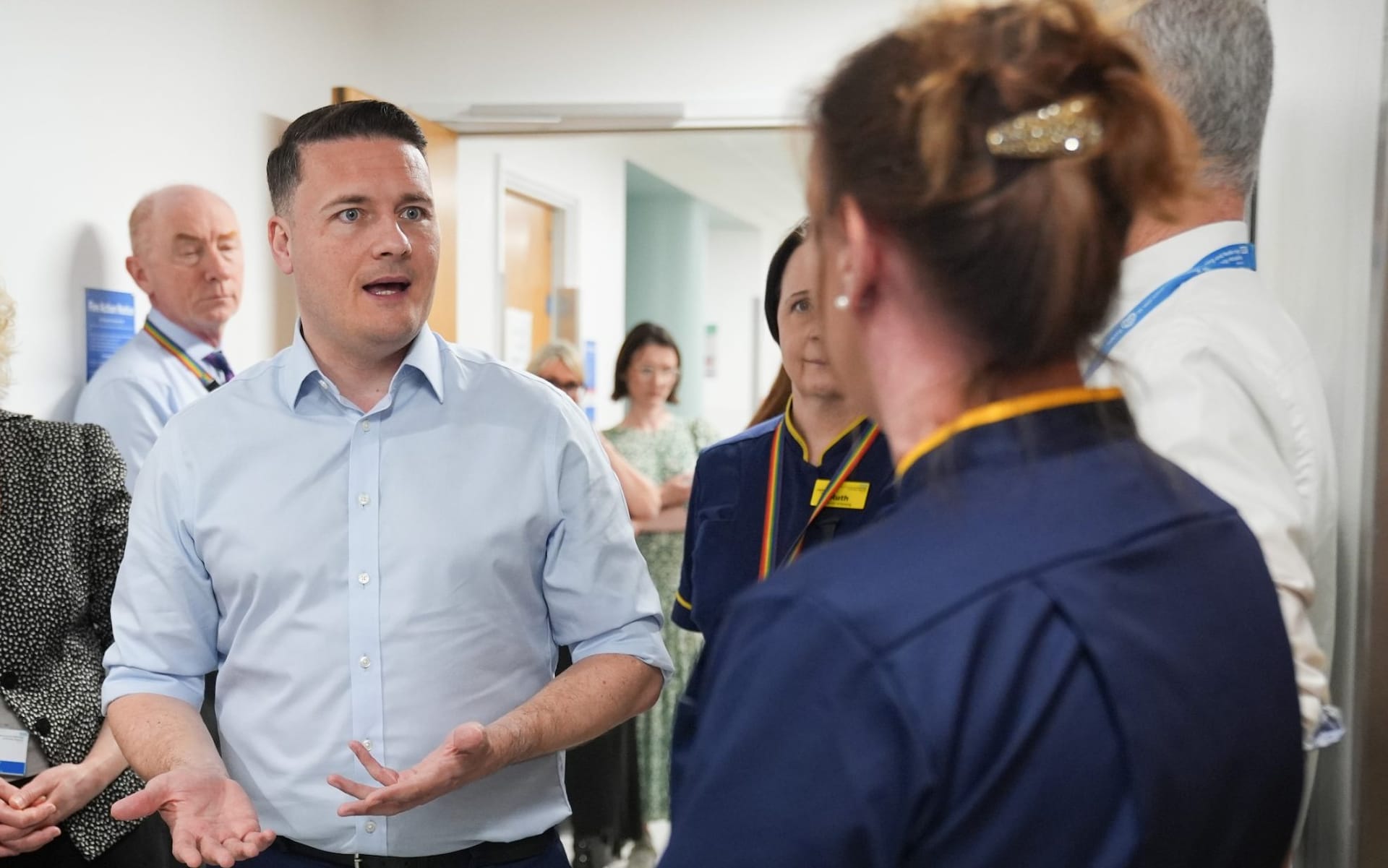
STREETING CLAIMS TO HAVE FIXED THE NHS. HERE’S THE TRUTH
On becoming health secretary, Wes Streeting said the NHS was “broken”.
As he resigned on Thursday, less than two years later, he claimed the NHS under his watch was on course for “the fastest improvement in NHS waiting times in history”.
To support this claim, he relied on new data, published just hours before his resignation, which revealed the biggest monthly drop in the waiting list since 2008, excluding the pandemic.
The 110,000 drop in March brought the backlog down to 7.11 million and meant he had achieved only the “interim” target set by Sir Keir Starmer of treating 65 per cent of patients within 18 weeks.
But closer analysis of the data underpinning this accolade show it is almost entirely attributable to patients being removed from waiting lists rather than more people being treated.
The Telegraph previously revealed the extent to which the NHS was using “unreported removals” to claim success on bringing down the waiting list.
More than 351,000 cases were removed from the NHS waiting list in March without the patient receiving treatment, about 100,000 more than the average over the previous 12 months.
It ensured an unprecedented jump of three percentage points in the number of people being seen within 18 weeks, tipping the NHS, and Mr Streeting, into the green.
These removals are part of “validation exercises” performed by the healthcare service to remove patients on the waiting list who, in theory, no longer needed care.
Typically, these people have either received private healthcare for their issue, died, or their circumstances have otherwise changed.
Health chiefs claim that patients are scrubbed only if they no longer need nor want the procedure they were waiting for, often including those who received some care.
The NHS denies this is why the waiting list is falling.
Hospitals were paid £33 by the organisation for every patient pulled off the list throughout the last financial year, while there has also been a £120m “sprint” to meet the target since January.
However, there are genuine concerns that patients are being kicked off the waiting list, with some hospitals also threatening to remove those who do not respond to requests confirming they still need an appointment.
Stuart Andrew, the shadow health secretary, told The Telegraph that Mr Streeting had “been massaging the waiting list figures” for months.
“A 90,000 increase in unreported removals is not about more treatments. It’s more massaging,” he said.
“Remember when Keir Starmer and Wes Streeting used to spout out the line that they had delivered five million extra appointments? They soon dropped that when Kemi Badenoch pointed out the last Conservative Government delivered 6.5 million.
“This Labour Government are trying to con the British people and taking patients for fools, but we all know they are failing to deliver real cuts to waiting lists.”
It was revealed in March that health officials had ordered this blitz on the backlog to meet Labour’s targets by the end of the financial year, which they were claiming victory on.
Shortly afterwards, the Office for Statistics Regulation admonished the NHS for this practice, telling officials there was a “need for greater transparency” on these waiting list removals. The NHS now publishes waiting list removals every month.
In his resignation letter, Mr Streeting cited other victories on ambulances, A&E waits, patient satisfaction and GP recruitment.
By some metrics, he has left the NHS in better shape than he found it.
The waiting list is down, people are finding it easier to see their GP, and satisfaction with the NHS is up for the first time since 2019, albeit from a record low.
But in other areas, he has been found wanting.
Patients are more likely than ever to face 12-hour waits in A&E corridors.
Junior doctors are still on strike as part of a more than three-year dispute, despite the almost 30 per cent pay rise he has awarded them.
And his billion-pound gamble to abolish NHS England, the biggest quango in the world, is only half-complete and has been described as “a monumental waste of time” by think tanks.
Mr Streeting, who is the MP for Ilford, also told Sir Keir that under his watch A&E waits are improving.
However, this is only true against the four-hour target, with 77 per cent of patients seen within that timeframe in the past two months.
It had previously been hovering around 75 per cent, which was similar to the last Conservative government, albeit demand had increased.
This success was not felt throughout the emergency departments, with elderly patients increasingly left waiting for a hospital bed in corridors and cupboards.
In January, more than 71,500 patients waited 12 hours in A&E for a hospital bed, which was the highest monthly figure since records began in 2010.
In April, this figure stood at 47,750, which is the highest for the time of year.
Dr Vicky Price, president of the Society for Acute Medicine, said the issue of corridor care was “being disguised rather than resolved”.
She said there was “gamification happening on a significant scale” with patients being out of sight or into same-day emergency care capacity, designed to improve flow.
She said this “may appear to improve statistics but actually worsens flow and doesn’t improve care”.
“Today’s data shows a 7 per cent increase in delays of over 12 hours in emergency departments compared to April last year. It is evident acute and emergency care remains at crisis point.”
On improving GP access, Mr Streeting has made it mandatory for surgeries to let patients book appointments online.
Survey data from the Office for National Statistics suggest it is now easier to get an appointment, and satisfaction is up.
In his resignation letter, the outgoing health secretary also said he had delivered his promise to recruit 2,000 more family doctors.
However, this is not a net improvement, as it does not account for those who have quit or equate to full-time GPs of which there are increasingly few.
Official data show that there are now 28,906 “full-time equivalent” GPs across England, which is 1,244 more than when Mr Streeting took charge.
But it is still almost 500 fewer than September 2015 despite the population of the country growing by around four million.
Mr Streeting told Sir Keir these were “all good reasons for me to remain in post”, but that it would be “dishonourable” to continue after losing confidence in the Prime Minister. He concluded his letter by saying it had been the “greatest joy of my life”.
Whoever is next appointed health secretary will be the ninth appointment in less than nine years, and by Mr Streeting’s own admission in the hours before he resigned, there is “still lots more to do”.
Meanwhile, Mr Streeting faced the seemingly insurmountable challenge of becoming the first person to have run the NHS and then be appointed Prime Minister.
2026-05-14T19:15:43Z